
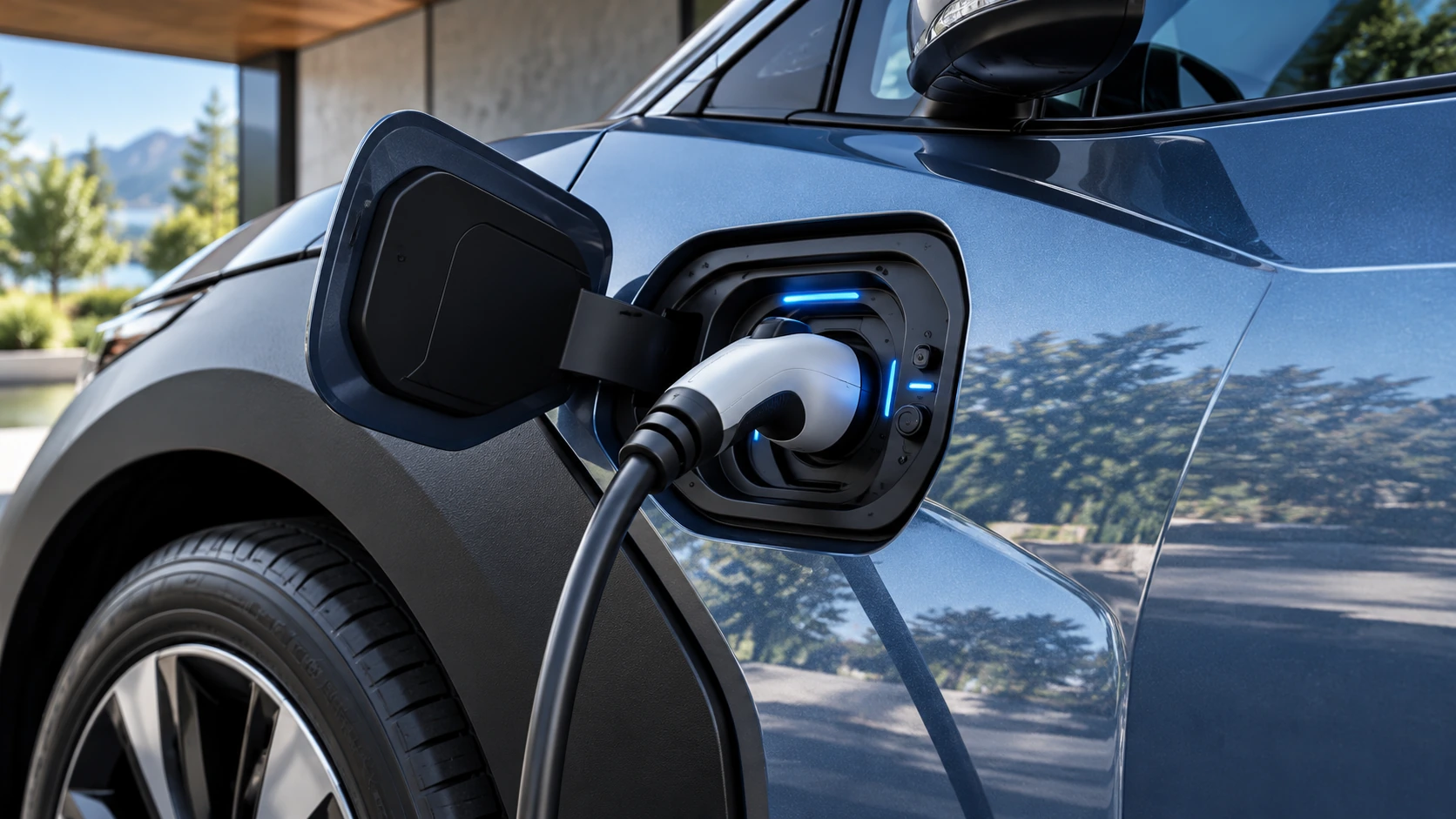
Before charging the traction battery of the Subaru Solterra, it is essential to carefully review the following precautions to ensure safe, efficient, and reliable charging operations.
■ Safety functions
- The Subaru Solterra is equipped with built-in safety mechanisms that prevent the EV system from starting while the charging cable is connected, even if the power switch is operated.
- If the charging cable is connected while the "READY" indicator is illuminated, the Subaru Solterra will automatically shut down the EV system, and driving will no longer be possible until the cable is disconnected.
WARNING
■ Caution when charging
Individuals with implantable cardiac pacemakers or cardiac resynchronization therapy devices should not perform the charging procedure for the Subaru Solterra. Charging should be handled by another person.
- Avoid approaching the charging equipment and AC charging cable while
the Subaru Solterra is charging.
The electromagnetic activity during charging may interfere with medical devices.
- Do not remain inside the Subaru Solterra while charging is in progress.
The charging process may affect the operation of sensitive medical equipment.
- Do not enter the vehicle, even briefly, to retrieve items from the luggage
compartment during charging.
This precaution helps reduce potential interference with medical devices.
■ When the charging cable is connected to the vehicle
Always keep the shift position in P while the Subaru Solterra is connected to a charging cable.
In rare cases, if the charging cable is damaged, there is a possibility that the shift position could change unintentionally, potentially causing the vehicle to move and increasing the risk of an accident.
■ Charging precautions
The Subaru Solterra is designed to be charged using an external power source via a dedicated AC charging cable compatible with standard household outlets.
However, due to the high electrical demand and continuous current flow required during charging, the Subaru Solterra differs significantly from typical household appliances. Improper handling or incorrect usage may result in electrical hazards such as fire or electric shock.
- During charging, a high level of electrical current flows continuously for an extended period of time.
- Depending on environmental conditions, charging may need to be performed outdoors in a suitable location.
NOTICE
■ Charging precautions
To ensure proper charging of the Subaru Solterra, carefully follow all procedures after fully understanding the instructions provided. Charging operations should only be performed by individuals who are familiar with the process and safety requirements.
- Do not allow inexperienced individuals, such as children, to operate
the charging system without supervision.
Always keep the AC charging cable out of reach of infants and unauthorized users.
- When using a charging station, strictly follow the instructions specific to that charger to ensure safe operation with the Subaru Solterra.
Confirm the following before charging
Before initiating charging, always double-check that all conditions are suitable for safe operation. Ensuring proper setup and adherence to guidelines will help Subaru Solterra owners avoid potential hazards and maintain long-term system reliability.
Before initiating the charging process for your Subaru Solterra, it is essential to carefully verify the following conditions to ensure safe and efficient operation.
- Confirm that the parking brake of the Subaru Solterra is firmly applied.
- Ensure that the power switch is fully turned to the OFF position.
- Check that all electrical systems, including headlights, hazard lights, and interior lighting, are switched off.
If any of these electrical components remain active, they will continue to draw power during charging, which may extend the overall charging time of the Subaru Solterra.
Inspecting the AC charging cable
Prior to connecting the Subaru Solterra to a power source, thoroughly inspect the AC charging cable and all related components to confirm they are in proper working condition and free from visible damage.
■ During charging
- The time at which charging begins may vary depending on the current condition and system status of the Subaru Solterra. Such variations are normal and do not indicate a malfunction.
- While charging, operational sounds may be heard near the traction battery area. These sounds are typically associated with systems such as the battery cooling system or air conditioning components working to regulate temperature.
- The surface of the CCID (Charging Circuit Interrupting Device) may become warm during operation. This is expected behavior and not a sign of a fault in the Subaru Solterra charging system.
- In some environments, minor radio interference may occur due to electromagnetic activity during charging.
■ AC charging and DC charging
The Subaru Solterra does not support simultaneous AC and DC charging.
Even if both charging connectors are physically attached, only one charging method will be active at a time.
■ When charging using a public charging facility, check the setting of the charging schedule function.
- If a charging schedule is configured in the Subaru Solterra, temporarily disable the schedule or activate the "Charge Now" function before connecting to a public charging station.
- When the charging schedule is active, the Subaru Solterra may not begin
charging immediately even after the cable is connected.
In such cases, charging fees may still be incurred depending on the charging station’s billing policy.
■ Capacity reduction of the traction battery
As with all lithium-ion batteries, the traction battery in the Subaru Solterra will gradually experience a reduction in capacity over time. The rate of this reduction depends on factors such as environmental conditions and driving habits.
To help preserve battery capacity and maintain optimal performance of the Subaru Solterra, consider the following recommendations:
- Avoid leaving the vehicle parked in high-temperature environments or under direct sunlight when the battery is fully charged.
- Minimize rapid and repeated acceleration and deceleration.
- Avoid prolonged high-speed driving whenever possible.
- Utilize the charging schedule feature to ensure the traction battery is fully charged just before departure.
- Limit the frequency of DC fast charging sessions when not necessary.
As the battery capacity gradually decreases, the driving range of the Subaru Solterra may also be reduced.
However, it is important to note that this does not significantly impact the overall driving performance or reliability of the vehicle.
■ When the remaining charge of the traction battery is low after charging
If the remaining charge level appears lower than expected after charging, it may be influenced by temperature conditions, battery management processes, or recent usage patterns of the Subaru Solterra.
Ensuring proper charging habits and maintaining optimal environmental conditions can help improve battery efficiency and consistency over time.
Under certain conditions, the Subaru Solterra may intentionally limit the final charge level of the traction battery after charging is completed in order to preserve long-term battery health. As a result, the available driving range immediately after a full charge may appear slightly reduced compared to normal expectations.*
- Charging the Subaru Solterra in extremely low or high ambient temperatures
- Charging immediately after high-load driving or exposure to intense heat conditions
In these cases, the battery management system of the Subaru Solterra actively protects the traction battery from stress, which may result in a lower-than-usual usable charge.
If, under normal environmental conditions, the remaining charge level appears significantly lower than expected after charging, it is recommended to have the Subaru Solterra inspected by an authorized SUBARU dealer.
*: In such situations, even when the display indicates that the battery is fully charged, the available range may decrease more quickly than usual due to protective energy management strategies.
■ When the charging amount sent to the traction battery decreases
In the Subaru Solterra, certain systems such as the air conditioning unit or the traction battery heater may draw energy during charging. When this occurs, the effective charging power delivered to the traction battery may be reduced, which can lead to a lower apparent increase in battery charge.
■ Certification
The Subaru Solterra charging system complies with Part 15 of the FCC Rules. Operation is subject to the following conditions: (1) the device must not cause harmful interference, and (2) it must accept any interference received, including interference that may result in undesired operation.
■ Charging time may increase
Charging duration for the Subaru Solterra may vary and become longer than usual under the following conditions:
- Extremely high or low ambient temperatures affecting battery efficiency
- When the traction battery temperature is elevated, such as after extended high-load driving
- When electrical systems such as headlights or other accessories are actively consuming power
- When operating features like "My Room Mode"
- In the event of a power interruption during charging
- When the charger is regulating or adjusting the power supply
- When there is a drop in voltage from the external power source
- When the 12-volt battery charge level is low, for example after long periods of inactivity
- When the charging current limit is modified through vehicle settings
- When the traction battery heater is operating
- When the "Battery Cooler" has been activated prior to charging
- When excessive heat is generated at the plug due to a loose or unstable outlet connection
- When DC fast charging is used frequently in a short period
- When the "DC charging power" setting is not set to "MAX"
- When charging-related components reach elevated temperatures
■ AC charging electricity
The Subaru Solterra supports AC charging with a maximum output of approximately 7 kW under optimal conditions.
However, the actual charging power may be limited depending on the specifications of the charging equipment, the AC charging cable used, and the electrical infrastructure available.
Understanding these factors allows Subaru Solterra owners to better manage charging expectations, optimize battery health, and ensure efficient operation under a wide range of conditions.